The Silent Siphon: How Cursor and Elon Musk’s AI Ecosystem Are Secretly Bleeding Developers Dry
If you’ve noticed your API balances and subscription credits evaporating into thin air faster than a lightweight script on a GPU cluster, you’re not paranoid—you’re being systematically drained.
A pattern of predatory UX design and aggressive default resets in Cursor Desktop has turned routine software updates into an automated cash grab, directly funneling developer capital into top-tier AI infrastructure—most notably Elon Musk’s overpriced Grok models.
Here is how the scheme works, why it’s happening, and the exact ledger of a victim targeted by forced upgrades.
The Scam Mechanics: Forced Defaults & Stealth Upgrades
The playbook is simple, subtle, and exceptionally lucrative:
- The Silent Switch: You set your Cursor environment to run lightweight, cost-effective models suitable for standard code completion and local context.
- The Update Trap: Cursor pushes a desktop update. Behind the scenes, the release logic silently overwrites your custom model preferences, forcing your default engine back to maximum-tier options: GROK MAX, paired with FAST mode routing.
- The Unwitting Drain: You reopen the editor and continue typing. Without warning or a clear UI prompt indicating your model settings were altered, every single agentic edit, Composer context pull, and auto-complete request shoots through high-tariff pipelines.
- The Invoice: Before you realize your settings were hijacked, your usage-based balance or monthly quota is wiped out.
By masking forced setting resets as standard product maintenance, Cursor and partner model providers create an artificial spike in token consumption. Developers pay enterprise-tier rates for basic daily tasks they intended to run on budget models.
The Paper Trail: A 40-Day Bleed
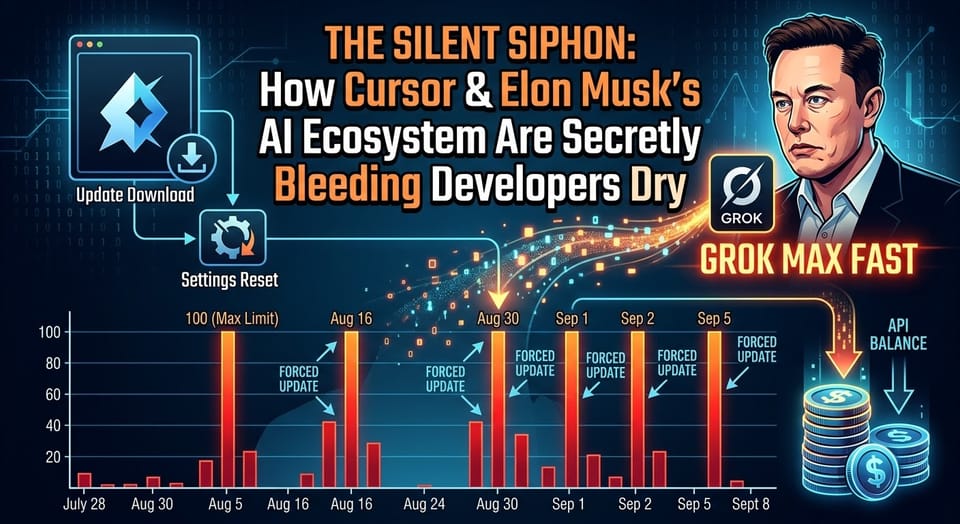
The proof lies in the consumption spikes following stealth updates and reset triggers. Here is a direct log tracking daily token drain under hijacked defaults:
Date | Usage Metric / Cost Hit | Model Routing / Event Context |
|---|---|---|
July 28 | 40 | Baseline activity; standard model configured |
August 2 | 60 | Initial usage escalation post-patch |
August 4 | 80 | Rapid token burn |
August 5 | 100 (Max Limit) | Quotas exhausted under forced GROK MAX FAST |
August 6 | 20 | Manual throttling / temporary quota reset |
August 12 | 45 | Moderate usage under non-standard settings |
August 16 | 100 (Max Limit) | Quota cleared out by unannounced background update |
August 30 | 100 (Max Limit) | Continuous max-tier drain |
September 1 | 100 (Max Limit) | Billing cycle reset immediately wiped out |
September 2 | 100 (Max Limit) | High-tier routing active without user consent |
September 5 | 100 (Max Limit) | Fifth peak usage burnout |
September 6 | 20 | Usage throttled |
September 8 | 31 | Settings manually audited and re-locked |
Notice the pattern: recurring 100-point spikes occurring in tight clusters (August 5, August 16, August 30 – September 5). In a normal developer workflow, consumption fluctuates naturally based on project milestones. These flatlined maximums reflect automated high-cost routing running invisibly in the background.
Why Elon Musk and AI Platforms Benefit
For AI companies competing for market share, token volume is the ultimate vanity metric—and the primary driver of revenue.
By pushing GROK MAX FAST as the forced default post-update, Cursor creates an artificially inflated demand loop:
- xAI (Musk) gets paid: High-cost Grok queries generate massive API token revenue at developer expense.
- Cursor hides behind "Performance Improvements": Updates are framed as user enhancements, while silently clearing out cost guards set by the user.
- The User Pays double: You pay once for the IDE/subscription, and twice through depleted usage caps caused by forced model upgrades.
The Verdict: Dark Patterns in Developer Tools
Software tools designed for engineers should respect user configuration above all else. Overwriting explicit cost settings upon updating is not a bug—it is a dark pattern calculated to monetize developer oversight.
Until Cursor fixes its configuration retention and provides explicit consent prompts before routing queries to high-cost models like Grok Max, developers must remain vigilant: Check your model settings after every single update, or pay the price for their forced defaults.
Member discussion